My Take on RAG: From Theory to Practicals
· 4 min read · Originally on Medium
Last week, I had an interesting discussion about Retrieval-Augmented Generation (RAG). It made me realize how many people in tech hear the term but don't actually know what it really means, how to build one, or even where to start tuning. So I thought: why not share my learnings with you all?
If you've been curious about RAG — the theory, the practicals, and even the pros and cons — here's my breakdown.
1. What is RAG?
Think of a large language model (LLM) like GPT as a really smart student with a great memory. But here's the catch: their knowledge is frozen at a certain point in time, and they don't know what's in your company docs, research papers, or private knowledge base.
That's where RAG comes in.
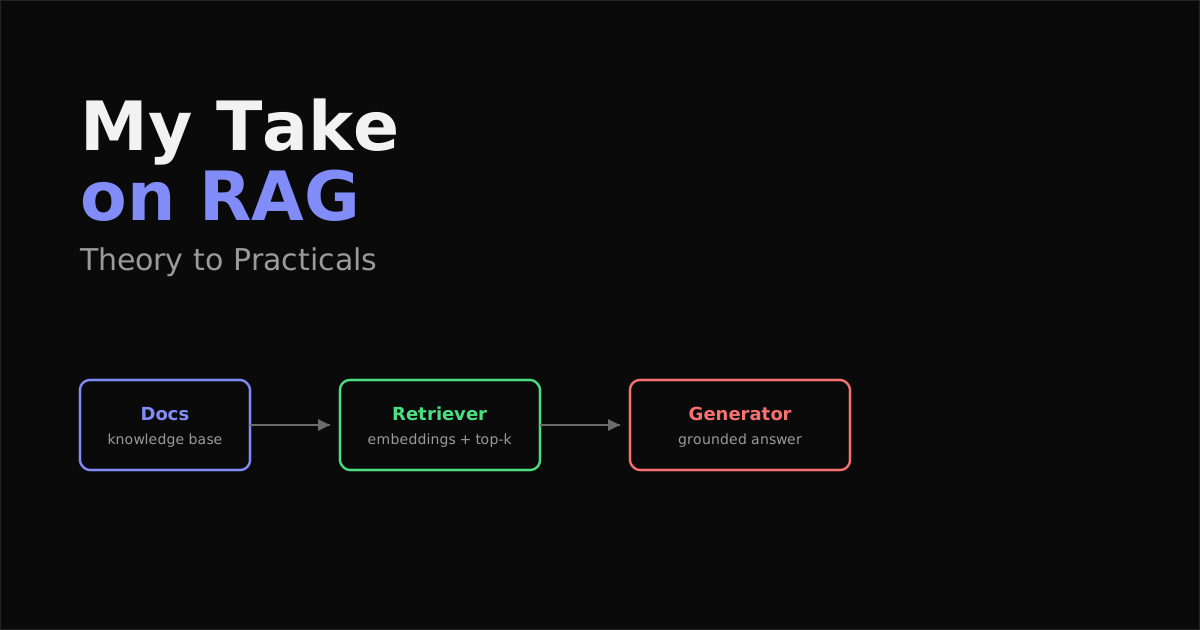
RAG = Retriever + Generator.
- The retriever searches your data (PDFs, databases, wikis, etc.) for relevant info.
- The generator (LLM) then uses that info to craft a grounded, context-aware answer.
It's like giving that smart student access to a library whenever you ask them a question.
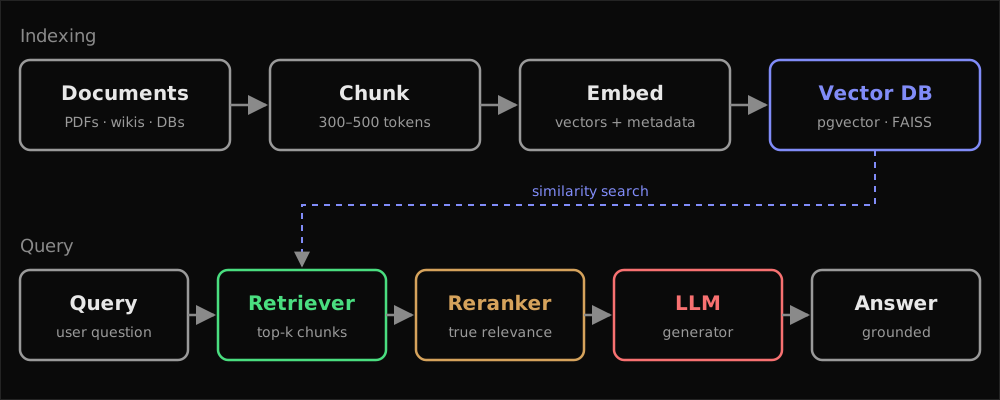 RAG: index documents into a vector DB, then retrieve, rerank, and generate
2. How to Tune the Retriever (The Real Magic)
Most people think the LLM is the star of the show, but honestly, the retriever makes or breaks your RAG system.
Chunking Strategy
- Split documents into smaller pieces (300–500 tokens).
- Use overlap so meaning doesn't get lost between chunks.
High-Quality Embeddings (Core of Retrieval)
Embeddings are vector representations of text — turning words, sentences, or documents into high-dimensional points.
- General-purpose models: OpenAI
text-embedding-3-large,text-embedding-3-small, Cohere, HuggingFace BGE. - Domain-specific models: BioBERT (biomedical), Legal-BERT (legal).
- Trade-offs: Larger embeddings → better semantic capture, but higher cost & storage.
- Multilingual: Use multilingual embeddings if your dataset spans multiple languages.
Rule of thumb: good embeddings = better retrieval.
Top-K Retrieval
- Top-K = how many chunks you retrieve.
- Too low (1–2): risk missing key context.
- Too high (10+): more cost, more noise.
- Sweet spot: 3–5, but tune based on dataset.
Hybrid Retrieval
- Mix semantic search (embeddings) with keyword search (BM25).
- This balances "semantic meaning" and "exact keyword match."
Rerankers
- Apply rerankers (cross-encoders or LLM-based scoring) to reorder results by true relevance.
Cost Awareness
- More chunks = more tokens → higher API cost + latency.
- Optimize with:
- Smaller embeddings for large-scale systems.
- Summarizing chunks before feeding into LLM.
- Self-hosted DB (FAISS, pgvector) to cut vendor costs.
Core Functions of a Retriever (AI Fundamentals)
Every retriever does 3 things:
- Encoding: Turn queries/docs into embeddings.
- Similarity Search: Compare query vector vs doc vectors.
- Selection: Pick the top-K most relevant chunks.
ERD for Embeddings & Metadata
When building RAG, it's important not just to store embeddings but also metadata like document titles, categories, or even SEO meta titles. This helps filtering and improves retriever quality.
- DOCUMENT: Original source (title, content, meta title).
- EMBEDDING: Vector representation of chunks.
- METADATA: Extra info (author, tags, category, language).
This structure allows filtering like:
"Retrieve top-5 chunks from docs tagged with finance created after 2023."
4. How to Build a RAG System
Here's a step-by-step blueprint:
- Collect → Gather knowledge base (PDFs, FAQs, wikis, databases).
- Preprocess → Clean, chunk, and embed docs.
- Store → Save embeddings + metadata in a vector DB (FAISS, Pinecone, Weaviate, pgvector).
- Retrieve → Search using embeddings + metadata filters.
- Rerank → Optional, improve quality before sending to LLM.
- Generate → Feed query + retrieved chunks into LLM.
- Respond → LLM outputs grounded answer.
5. Pros and Cons of RAG
Pros
- Grounded answers (less hallucination).
- Access to up-to-date data.
- Cheaper than fine-tuning models.
- Provides citations for transparency.
Cons
- Retriever bottleneck: weak retrieval = poor answers.
- Higher latency (retrieval + generation).
- Context window limits: can't overload LLM with too many chunks.
- System complexity: vector DBs, embeddings, and pipelines to maintain.
6. Final Thoughts
For me, the biggest "aha moment" was this: RAG isn't about making the LLM smarter — it's about giving it the right context at the right time.
To tune your RAG effectively, you need to balance:
- Embeddings quality → semantic accuracy.
- Top-K → enough context but not too costly.
- Cost → tokens and latency can scale fast.
- Metadata → helps filter noise and improve relevance.